Vous aimez mes articles et mes films de terrain ? Laissez-moi votre email : je vous préviens à chaque nouvel article et à chaque nouveau film sur YouTube, avec une citation en prime.
Pas 40 mails par semaine : j'ai aussi des chemins à explorer !
There are landscapes that don't try to impress. They are simply there, standing in the face of time, silent and motionless, as if they have always been watching the sea.
1. The moment
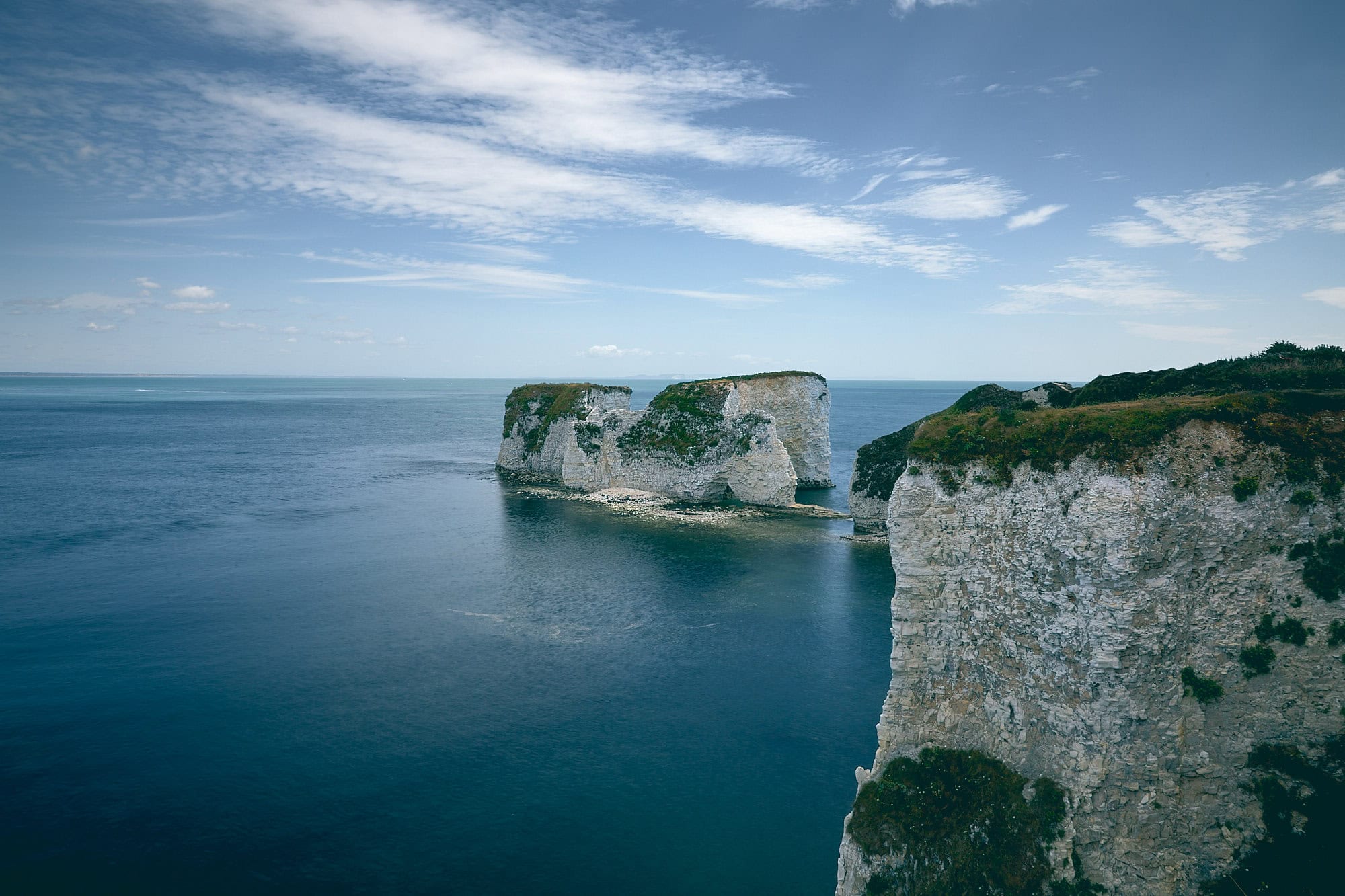
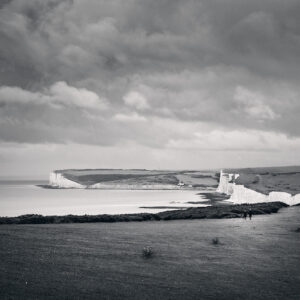
This image was taken on a calm day, without spectacular light or extreme conditions. The sky was slightly hazy, the sea surprisingly peaceful for this exposed coastline, and the air charged with that special feeling you get when everything seems in balance. It was a moment suspended in time, without urgency, conducive to observation and strolling around rather than looking for a particular effect.
2. The location - Old Harry Rocks
The south coast of England is marked by the limestone formations that erosion slowly shapes, year after year. Here, the rock tells a story that goes back much further than our time here: These cliffs have been built and transformed over almost two hundred thousand years by the combined action of the sea, wind and time. It's here that the sensation of being deeply anchored is born, almost reassuring, offered by a scale of time that goes far beyond us. Faced with it, the human presence seems infinitesimal, fleeting, as if suspended in a much larger movement, naturally inviting calm, contemplation and a form of silent meditation.. 🤫
The cliffs stand out clearly against the horizon, massive yet fragile, constantly sculpted by the elements. These are places where you immediately sense the tension between apparent solidity and slow disappearance, where each stratum seems to remind us that the landscape is in motion, even when it appears motionless.
Naturally, these spaces require us to stand back. They invite us to observe before we even think of photographing, to be aware of the scale of time and the modest place we occupy in the face of such formations.
3. The situation
Access to the site is relatively straightforward. It's about a forty-minute walk on generally flat ground, making it a popular spot for walkers. So the difficulty is not physical, but photographic..
Once there, the real work begins. It's not just a case of getting to the edge of the cliff and firing the shutter. I spent a lot of time driving along the coast, testing out different viewpoints, Explore these rocky outcrops that stretch out to sea, forming natural undulations along the coastline.
These formations allow you to move slightly away from the general line of the coast, to open up the frame in a different way, without falling into an overly frontal or expected view 🧐. It's not a particularly original approach, but it's often the right one if you want to maintain a balanced view of the landscape..
After several attempts, one point of view stood out, not because it was obvious, but because it was consistent. The kind of place where you feel the frame works, even without trying to go any further... except perhaps with a drone, but that's another story. 🤓
4. Shooting
The choice of focal length was decisive. Long enough to isolate the rock formations, but not so long as to overwhelm them or lose the relationship with their environment. I wanted to preserve this reading in successive planes: the sea first, calm and deep, then the rock, massive, and finally the sky, light, almost erased....
The settings were kept simple. A moderate aperture to keep the textures legible, sufficient shutter speed to freeze the surface of the water, and low sensitivity to preserve the smoothness of the transitions. Here, the technique was not intended to stand out, just to accompany the eye.
5. The look afterwards
Looking back, this image speaks to me above all about time. Long, slow, almost imperceptible time, the kind that shapes rock and transforms landscapes far beyond our presence. Nothing is set in stone, everything seems motionless but is in fact alive, moving to its own rhythm.
It's a silent photograph, without effect or emphasis, but one that continues to resonate through its simplicity. It's a reminder that some places don't need to be interpreted or explained: they simply require us to take the time to look at them.
6. In conclusion
This image of Ol Harry Rocks in Swanage is not the memory of a particular effort or an exceptional condition. It is the result of time taken, a walk, patient observation and a framework found rather than constructed.
Photographing this type of landscape means accepting that you can't control everything, that you have to work with what's already there, and that you simply have to be in the right place at the right time. The rest is up to the place, the time... and the way you look at the image.