Vous aimez mes articles et mes films de terrain ? Laissez-moi votre email : je vous préviens à chaque nouvel article et à chaque nouveau film sur YouTube, avec une citation en prime.
Pas 40 mails par semaine : j'ai aussi des chemins à explorer !
Choosing a photo for your wall might seem simple at first. You see an image, you like it, you imagine it in your living room, your office or your bedroom…🥳 then the questions start. What size should you choose? Should you prefer a colour or black and white photo? Will the image go with the decor? Won't you get tired of it eventually?
A wall mural is not just a decorative object. It's a presence. It accompanies a room, it draws the eye, it creates an atmosphere. Sometimes it soothes. Sometimes it gives depth to a slightly bare wall. Sometimes, too, it evokes a place, a light, a season, a silence.
So, how do you choose a picture for your wall without making a mistake? The right answer isn't just a matter of colour or size. It's primarily about finding the balance between the emotion, space, and harmony of your interior..
1. Choose a photo that truly touches you
Before you think about the size of the frame or the colour of the sofa, start with a simple question: What does this photo make you feel?
A beautiful wall mural should evoke something. It can evoke calm, escape, strength, solitude, light, freedom or gentleness. It doesn’t need to be spectacular to be right. Certain very simple images, such as a path in the mist, a calm sea, a silent forest or a distant mountain, can have much more impact than an overly busy image.
It is often this first emotion that allows a photograph to stand the test of time. A decorating trend can pass. A fashionable colour can bore you. But An image that really speaks to you will keep its place.
When choosing a photo for your wall, don't just look for what “goes well” with your interior. Also look for what resonates with you. A successful photograph in a home is one that you enjoy looking at, even subtly, day after day.
2. Consider the atmosphere of the room
Each room has its own rhythm. A living room doesn't have the same energy as a bedroom. An office doesn't have the same role as a hallway or an entrance. The photo you choose should complement the atmosphere of the space, not clash with it.
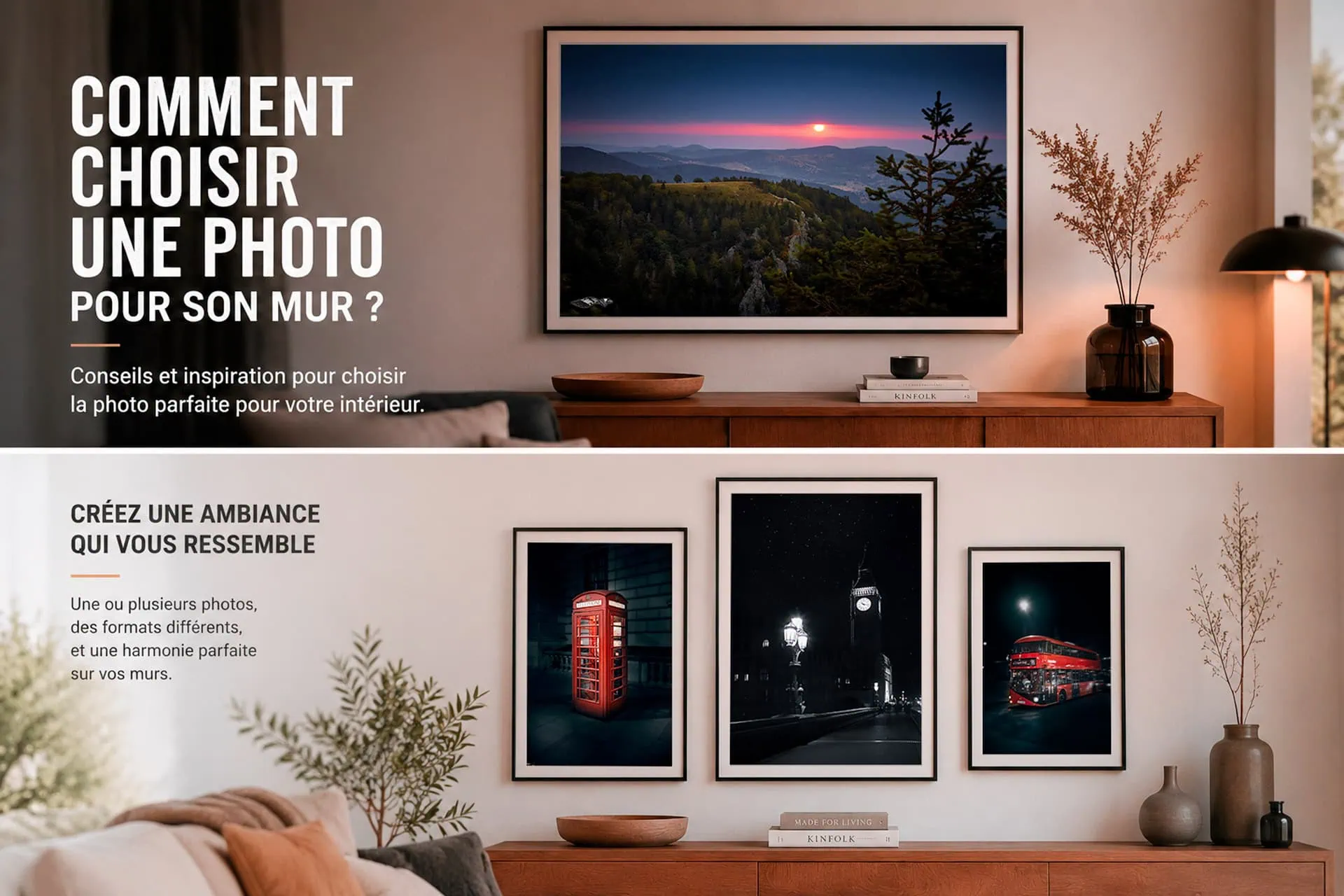
In a living room, a photograph can become a real focal point. This is often the room where you can dare to go for a more generous format, a stronger image, an open landscape or a composition that naturally draws the eye. A nature, travel or landscape photograph can give a sense of openness, especially in an urban or rather enclosed room.
In a bedroom, one would rather look for a calming image. Soft tones, calm lighting, a clean subject or a minimalist composition often work very well. The aim is not to impress, but to create a sense of rest.
In an office, a photo can help you take a mental breather. A horizon, a forest, a road, a seaside or a mountain scene can offer a form of visual escape. This is a simple way to introduce depth into a sometimes very functional space.
In an entrance hall or corridor, a photograph can set the tone from your very first steps. It creates a first impression. It can be understated, graphic, bright, or conversely, more personal.
3. Adapt colours to your interior
Colours play an essential role when choosing a wall photo. It's not necessarily about perfectly matching the photo to the sofa, curtains, or rug. Too perfect a harmony can sometimes feel a bit cold. But It is important that the image dialogues with the piece.
Observe the dominant colours in your interior. Is your decor rather light, natural, woody, minimalist, industrial, warm, or colourful? A soft-toned photo will easily integrate into a calming atmosphere. A more contrasting image can bring character to a minimalist space. A photo with blues, greens, or earthy tones can enhance a natural atmosphere.
The simplest approach is to identify two things: the colours already present in the room, and then the emotion you want to add. A photo of the sea can bring freshness. A forest can add depth. A golden sunset scene can warm a white wall. A misty image can soften a very structured room.
Decor guides often recommend considering the room's colour palette before choosing wall art, as an image that is too far removed from the general atmosphere can seem disconnected from the overall scheme.
4. Choosing the right format for the right wall
Formatting is one of the most common mistakes. Many people choose a photo that's too small out of caution. However, on a large wall, a small image can quickly look lost.
A large wall often calls for a more generous photograph. This doesn't mean you necessarily have to opt for an immense print, but the image needs to have enough presence. For a wall above a sofa, sideboard, or bed, a common rule is to choose a piece of art that occupies approximately two-thirds to three-quarters of the width of the furniture or available space.
The horizontal format works very well above a sofa, bed, or low cabinet. It naturally follows the lines of the piece and gives a sense of calm. The vertical format is ideal for a narrow wall section, an entrance, a corner, or to add height. Lsquare format, him, bring a impression of balance and stability.
You also need to consider the distance. A large photo needs space to be viewed. In a small hallway, it is sometimes better to choose a more understated image or a series of small formats. In an open-plan living room, a large print can, on the contrary, become a centrepiece.
5. Think about the light and the location
A photograph doesn't live the same way depending on the light surrounding it. Before hanging it, observe your wall at different times of the day. Is it exposed to direct sunlight? Is it in a dark area? Are there any reflections?
Indirect natural light is often ideal. It reveals the image without assaulting it. Conversely, direct and prolonged exposure to the sun can be problematic for some prints, in addition to creating distracting glare. Several interior design guides recommend avoiding direct sunlight and choosing a spot that is visible at eye level.
The hanging height also matters. A picture hung too high seems to float. Too low, and it loses its elegance. As a general rule, The centre of the image should be around eye level. That varies depending on the room, the furniture and the size of the print run, but it’s a good starting point.
Also consider the space around the photograph. An image needs to breathe. If it's surrounded by strong objects, shelves, frames or colours, it can lose its presence. A calmer wall often allows photography to exist better.
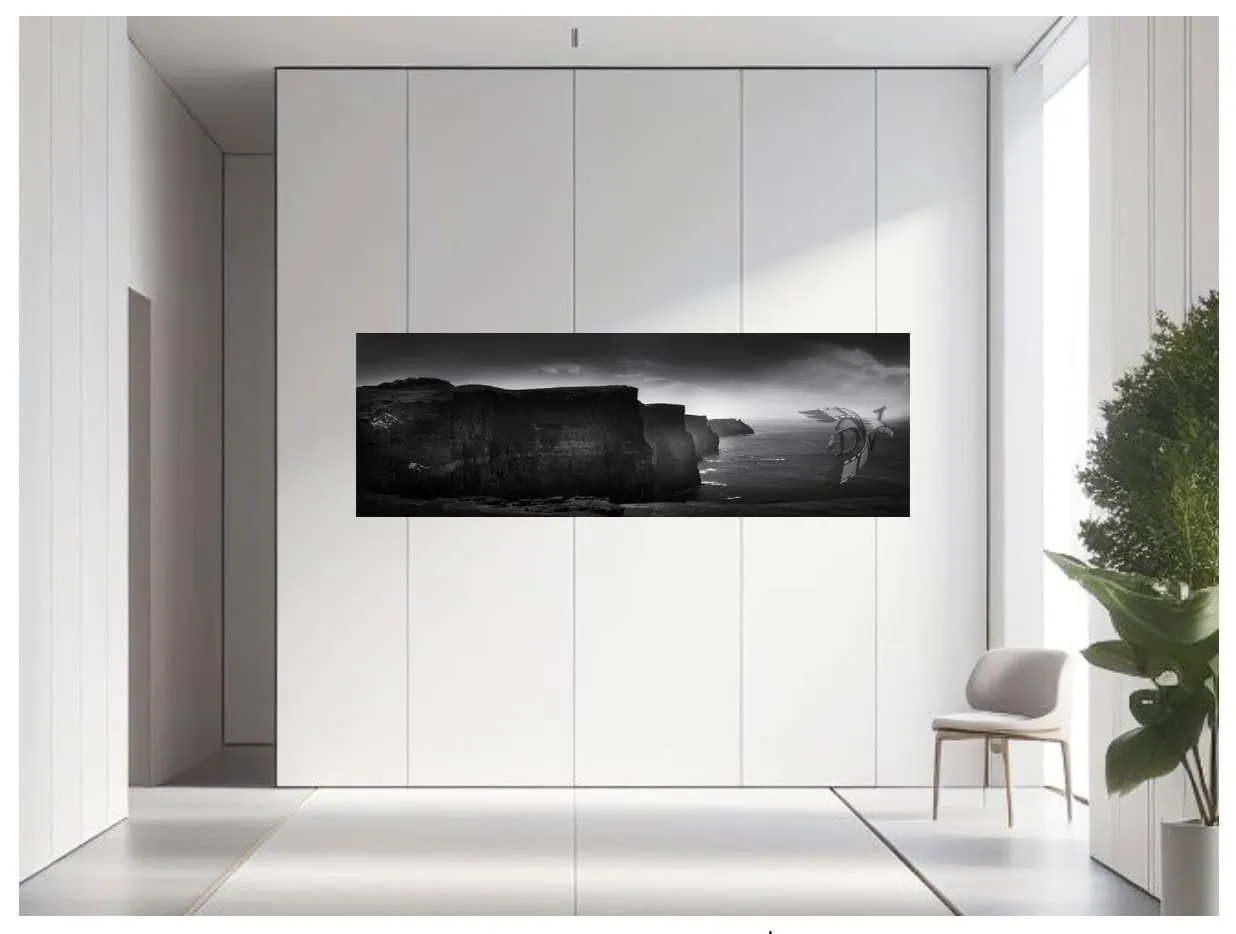
Wall-to-wall panoramic view
6. A single photo or a photo wall?
Should you choose a single large photo or create a gallery wall with several pictures? Both options can look stunning, but they don’t have the same effect.
A single photo creates a strong presence. It provides clarity, elegance, and a gallery-like impression. It is often the best choice if the image is powerful, if the wall is significant, or if you want understated and timeless decoration.
A wall of photos, on the other hand, tells a more fragmented story. It can mix several formats, several memories, several moods. It's a more personal, sometimes more vibrant, option. The trend of framed patchwork, which mixes photos, artworks, posters, and objects, remains very much present in contemporary wall decoration.
To maintain good consistency, it's better to choose a common thread. This could be a range of colours, a natural theme, a series of landscapes, a framing style, or an alternation between black and white and soft tones. Without this common thread, the whole can quickly appear confusing.
If you hesitate, Start with a strong photo. It can live alone initially, then later become the starting point for a wall composition.
7. Black and white or colour: which to choose?
Black and white has a particular power. It strips away the superfluous, emphasising shapes, light, textures and contrasts. A black-and-white photograph is ideal for understated, contemporary, minimalist or elegant interiors. It often lends a timeless quality.
Colour, on the other hand, has a greater impact on the atmosphere. It can make a room feel warmer, cooler, more soothing or more vibrant. A colour landscape photograph can transform the way a space is perceived. A deep blue opens up the imagination. A forest green calms the eye. Sandy, stone, or misty tones create a soft and natural ambiance.
The choice therefore depends less on a rule than on the desired effect. If your room already has a lot of colours, a black and white photograph can bring balance. If your décor is very neutral, a colour photograph can serve as a visual focal point.
The important thing is not to choose black and white simply because it seems “more artistic”, nor colour simply because it seems “more decorative”. Both can be powerful. It all depends on the subject, the light and the emotion.
8. Choose a photo that breathes
A photo intended for display on a wall doesn’t need to show everything. On the contrary, The most powerful images are often those that leave space.
A landscape with a big sky, a calm sea, a lonely road, a mountain in mist or a silent forest can really breathe new life into a room. This notion of visual space is important. It allows the eye to rest without fatigue.
In an interior already rich with furniture, objects, or materials, a minimalist photo often works very well. It creates a pause. It doesn't add noise to the noise. It becomes A place where the eye can rest.
This is particularly true for nature photos. They have this ability to open an imaginary window. They don't just decorate the wall: they create a breakaway. 😍Depth in his/her photos?)
9. Bring nature into your home
Choose A photo of nature For his wall, it is not just about choosing a pretty landscape. It is about bringing in a feeling in its interior.
Nature soothes because it reminds us of something vaster than ourselves. A forest, a lake, a wild coast, a mountain or a changeable sky can alter the atmosphere of a room. without needing to overdo it. It's a discreet but profound presence.
In a world where our interiors are often filled with screens, straight lines, and functional objects, a nature photograph brings a sense of slowness. It invites us to look differently. It reminds us of the light of a morning, the silence of a path, the strength of a horizon.
This is also what makes a mural more personal than a simple decorative element. It can become a daily breath.
10. Avoid choosing based on trend alone
Trends can provide ideas, but they shouldn't make decisions for you. A photograph chosen merely because it conforms to a trend risks quickly losing its appeal.
Today, certain styles are very popular: neutral tones, minimalist landscapes, natural compositions, thin frames, large formats, gallery walls. But A good mural should be able to stay in place for many years without looking dated.
Will you still like this image in five years' time? Does it only suit your current interior, or does it also resonate with your deeper sensibilities? Does it tell a story that belongs to you?
The best photo for your wall isn’t necessarily the one that will impress your guests.
It's the one that will keep talking to you when the room is quiet. 🤫
11. Conclusion: a wall mural should live with you
Choosing a picture for your wall is about finding a balance between the gaze and the place. One must consider the size, colours, light, format, and placement. But one must also listen to what the image evokes.
A good wall photo doesn't simply fill empty space. It gives a room an atmosphere. It accompanies everyday moments. It can calm a living room, soften a bedroom, inspire an office, or add character to an entrance.
Before you choose, take the time to look. Imagine the picture in your home, in your light, with your furniture, your habits, your silences. And above all, choose a photograph that you will enjoy looking at again.
Because fundamentally, the right photo for your wall is one that isn't just beautiful. It's one that naturally finds its place in your life.