Vous aimez mes articles et mes films de terrain ? Laissez-moi votre email : je vous préviens à chaque nouvel article et à chaque nouveau film sur YouTube, avec une citation en prime.
Pas 40 mails par semaine : j'ai aussi des chemins à explorer !
In photography, composition, light, sharpness, colour, or contrast are often spoken of as if they were purely aesthetic choices. However, behind these artistic decisions lies a much deeper reality: Our way of seeing is not neutral.
The human eye doesn't read an image like a camera records a scene. It does not scan everything with the same importance. It selects, prioritises, compares, looks for points of reference, tensions, areas stronger than others. In other words, A photograph is never looked at in a completely objective way. It is interpreted by a living visual system, shaped by biology, experience, memory, emotion and instinct.
Understanding this changes a lot for the photographer. It's no longer just about “making a beautiful image,” but about to understand how the gaze circulates, where it lingers, what it ignores, what it feels first, and why some images seem immediately more powerful than others.
This is precisely where The physiology of the eye joins photographic composition, RAW development, tone work, colour grading anda construction site’a more personal look.
The eye sSelect
Contrary to what one might believe, our vision is not a faithful and complete reproduction of the world. The eye receives a large amount of information, but the brain cannot process everything with the same precision at the same time.
Human vision thus works by selection. Some information is considered high priority, while other information is pushed to the background. This mechanism is essential: it allows us to survive, orient ourselves, and quickly recognise a face, a danger, a movement, or a disruption in our surroundings.
In photography, this means that’An image is never perceived uniformly. Certain areas will immediately attract the eye, sometimes even before the viewer is aware of what they are looking at. These areas become visual entry points.
The photographer can experience this phenomenon, or conversely, use it consciously. An area that is too bright, too sharp, too contrasted, or too colourful can divert attention from the main subject. Conversely, A well-placed area, subtly enhanced by light, sharpness or colour, can guide the eye with great precision.
2. The retina: a sensitive, but uneven surface
The retina is the light-sensitive surface at the back of the eye. It converts light into nerve signals sent to the brain. It mainly contains two types of photoreceptor cells: cones and rods.
The cones are responsible for colour vision and fine detail. They are particularly concentrated in the fovea, a small central area of the retina that allows for the most precise vision. It is thanks to this area that we read, observe a detail, recognise a gaze or analyse a texture.
The rods, on the other hand, are more sensitive to low light and movement. They play a greater role in peripheral vision and the overall perception of the environment.
This organisation explains a fundamental point: We don't see the full picture with the same clarity. The focus of vision is precise, but very limited. The periphery is less detailed, but very sensitive to changes, movements, contrasts and breaks.
In photography, this means thatHis gaze constantly shifts.. It jumps from one point of interest to another. It seeks out areas of contrast, recognisable shapes, sharp details, strong colours or emotionally significant elements.
A good image is therefore not just a well-composed image. It's an image in which the movement of the gaze has been anticipated.
3. The natural hierarchy of the gaze
The human gaze seems drawn to certain elements in a relatively predictable order. This order is not an absolute law, but a strong tendency. It varies according to the subject, culture, experience and intention of the image, but it remains very useful for understanding visual reading.
In a photograph, the eye is generally drawn to :
Strong contrasts of light.
The clearest areas.
Faces, eyes, and human or animal shapes.
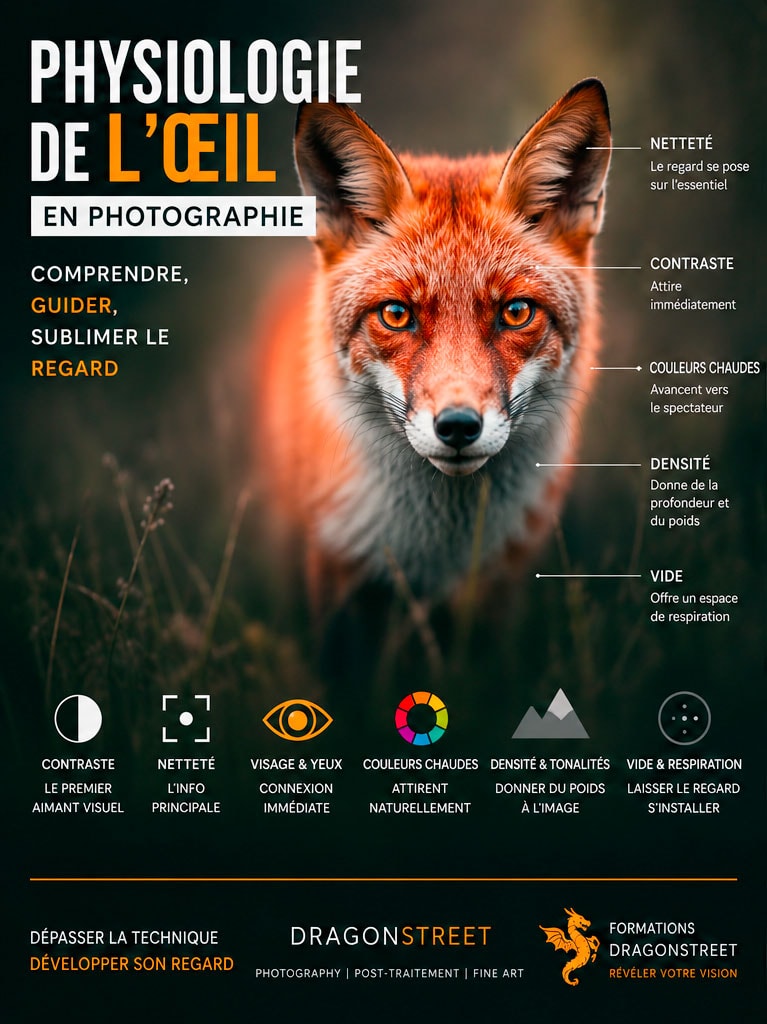
Warm or saturated colours.
Simple and recognisable shapes.
The lines, directions and repetitions.
Breaks in a pattern.
Bright areas in a dark environment.
Strong dark areas in a light environment.
The isolated elements in an empty space.
It is this hierarchy that gives an image its internal dynamic. A photograph can be technically successful, but confusing if several areas compete for attention.. Conversely, A very simple photograph can become powerful if it clearly organises the viewer's priorities.
4. The contrast: first visual magnet
Contrast is one of the main drivers of visual perception. The eye very quickly spots differences: light against dark, sharp against blurry, warm against cold, smooth against textured, full against empty.
The luminance contrast, that is to say the difference between light and dark values, is particularly powerful. A light area in a dark image almost always draws the eye.. A dark silhouette against a bright background produces the same effect.
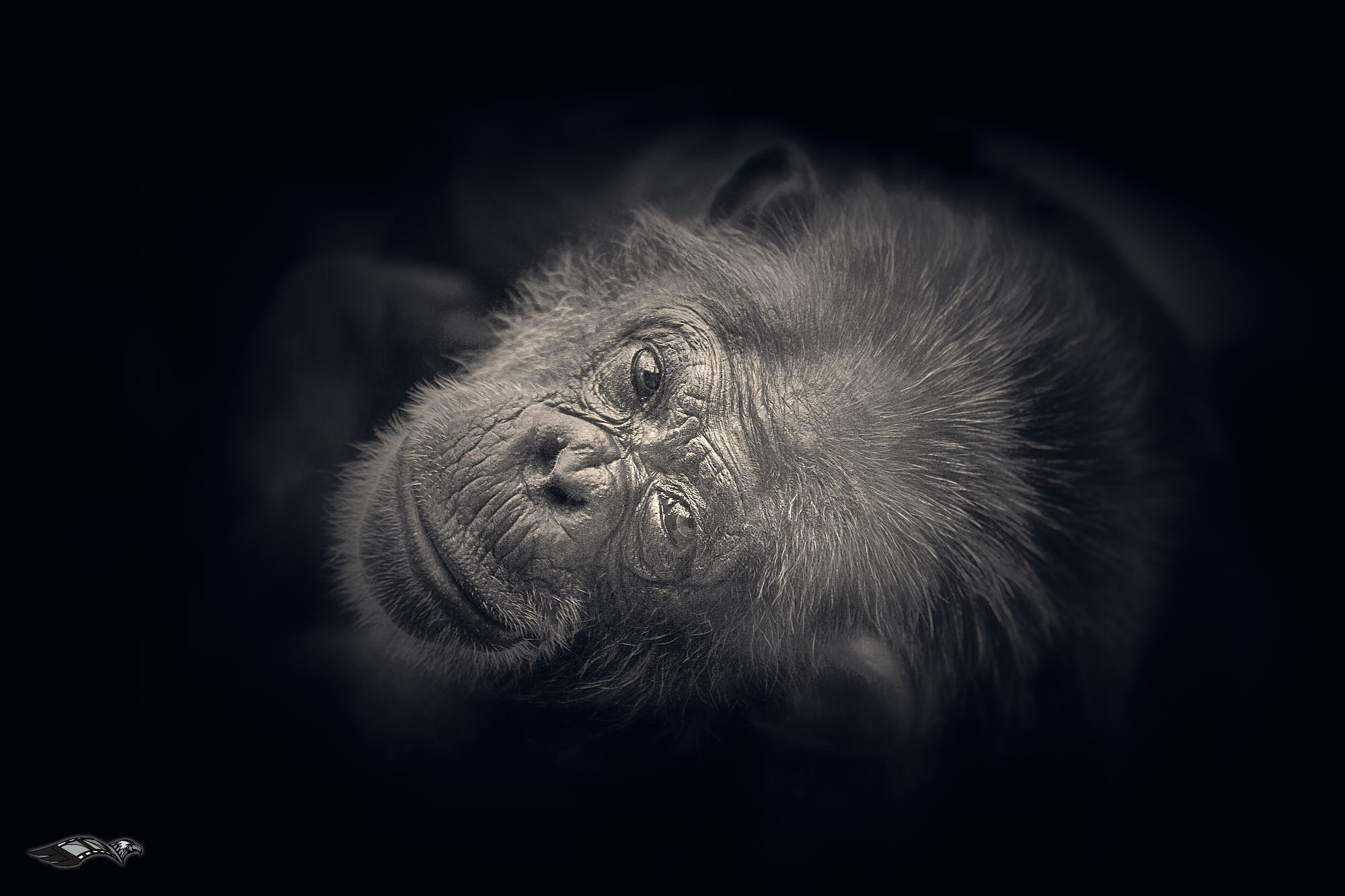
It's for this reason that black and white photographs can be so powerful.By removing colour, they compel the gaze to concentrate on values, masses, lines, densities and oppositions.
But the contrast should not be mistaken for a harsh or aggressive image. A contrast can be strong, but subtle. It can exist in the halftones, in a gentle transition, in an opposition between two close densities. It is often here that a finer, more mature, less spectacular but more profound image is born.
In photo development, managing contrast is therefore not simply about “adding contrast”. It’s about deciding where the image should speak louder, and where it should remain silent.
5. Density: giving weight to the gaze
Density is an essential concept in Fine Art photography. It is not limited to making an image darker. It concerns the visual weight, the presence of mid-tones, the depth of shadows, the way light and dark masses balance each other.
An image that is too light can feel unanchored. The viewer's gaze passes through it without really settling. Conversely, an image that is well-densified gives a sense of substance, stability, and sometimes even weight.
Middle tones play a major role here. It is often they that give a photograph its emotional depth. Middle tones that are too flat make the image descriptive. Middle tones that are too crushed can make it heavy. But well-sculpted mid-tones give the gaze a lively, rich, inhabited terrain..
In a Fine Art approach, density allows the gaze to slow down. It prevents the image from being consumed too quickly. It invites the viewer to stay, to search, to feel. In my opinion, this is a fundamental difference between an image that is merely effective and one that endures.
6. Sharpness: an immediate priority
The human eye is naturally drawn to what is sharp. Sharpness indicates an important, legible, accessible area. In an image where everything is blurry except for one detail, the gaze will almost always go towards that detail.
This is one of the most powerful principles in photography: Sharpness creates a hierarchy.
In an animal portrait, for example, if the animal's eye is sharp and the rest is softer, the viewer's gaze immediately focuses on that area. In a landscape, a highly textured or detailed area can become a strong focal point, even if it wasn't the main subject.
This is why sharpness should be used with discernment. An image that is too sharp everywhere can become tiring. She no longer leaves an area of rest for the gaze. She transforms the entire scene into competing information.
Conversely, blur, softness, bokeh, mist, atmospheric haze, or light diffusion allow for the reduction in the prominence of certain areas. They create perceptive and emotional depth.
The photographer should therefore not just ask themselves: “Is my image sharp?” They should instead ask themselves: “What needs to be sharp, and why?” 🤓
7. Warm colours attract faster than cool colours
In an image, warm colours (red, orange, yellow, gold) often have a very strong power of attraction. They seem to advance towards the viewer. Cool colours (blue, cyan, cool green, bluish grey) tend to recede, to soothe or to create distance.
This opposition of warm/cold is one of the most powerful tools in photographic colour grading, creating depth, moving from a flat 2D to a more 3D feel.
A small touch of warmth in a cold image can become an immediate visual entry point. A slightly flushed face will stand out naturally in a blueish ambience. A golden light at the back of a cold landscape can create an appeal, a direction, an emotion.
But again, it all depends on the dosage. 😮💨 A warm colour that's too saturated can become overpowering. It can crush the subtlety of the image. Conversely, a discreet warm colour, well integrated, can give a very strong vibration without falling into an easy effect.
In a mature photograph, colour is not just for embellishment. It serves to organise the observer's gaze.
8. The faces, the eyes and human forms
The human face possesses a particular visual power. We are biologically programmed to recognise faces, expressions, gazes, silhouettes, and body postures.. Even a small human form in an immense landscape can immediately become the focal point of the image.
The eyes are even more powerful. A sharp, even subtle, gaze can dominate an entire photograph. It creates a direct relationship between the subject and the viewer.
This also applies to animal studies. An animal's eye, a posture, a head orientation, a perceived expression can transform a simple descriptive photo into a living presence.
In the landscape, A human silhouette can give scale, but it can also steal attention. If it is too visible, too contrasting or placed too close to a focal point, it becomes the subject. If it is subtle, it can, on the contrary, reinforce the sensation of immensity, solitude or travel.
This is why you need to be very mindful of the space given to human or animal figures in an image. They are never neutral. 🧐
9. Lines guide, shapes stabilise
After contrasts, sharpness, faces, and colours, the gaze often follows lines. A road, a river, a branch, a mountain diagonal, a wave, a cast shadow or a succession of rocks can lead the eye into the image.
Lines create direction.They can speed up or slow down playback. A diagonal often gives movement. A horizontal calms. A vertical asserts. A curve softens. A spiral retains.
Simple shapes, on the other hand, stabilise the image. A triangle, a circle, a dark mass, a bright block, a light silhouette on a dark background: all of this helps the brain to organise the scene.
A photograph often becomes stronger when its main forms are legible. This doesn't mean it has to be simplistic, but that its structure should be able to be felt quickly. In a good image, the gaze is not lost. It is guided.
10. The void: an active zone, not an absence
In photography, negative space is often misunderstood. Many photographers are afraid of leaving too much empty space. However, Negative space is one of the most powerful ways to bring hierarchy to an image.
An isolated subject in a calm space becomes more important. Empty space around an element gives it room to breathe. The void allows the gaze to rest, then to return to the subject. It acts like a silence in music. He doesn't say anything directly, but he gives weight to what is said. 🤓 👌
In an overcrowded image, every detail demands attention. The gaze flits about. In a better-paced image, the subject can exist more powerfully. This is particularly important in a Fine Art approach, where the image seeks not only to show, but to make you feel.
11. Why do some photos tire the eyes?
A photograph can be spectacular, yet still tiring. This happens when too many elements vie for the eye's attention at once: too much sharpness everywhere, too much saturation, too much micro-contrast, too much detail, too many highlights, too many competing areas. The gaze doesn't know where to go. It jumps from one point to another without a clear hierarchy. The image becomes noisy.
On the contrary, a simpler, better organised photo, with one or two strong priorities, can be much more Pleasing to the eye. It gives direction, then leaves room for exploration. This is where photography almost joins a form of visual ecology. A good image doesn't unnecessarily overload. She chooses what she highlights. She agrees to leave certain areas in the background..
Photo development should follow this logic. It's not about revealing everything, opening everything up, accentuating everything, colouring everything. It's about understanding what the image really wants to show.
12. RAW development as a tool for visual hierarchy
RAW development isn't just a technical step. This is a staging step for the gaze.
Each slider can alter the image hierarchy:
The general lighting changes the dominant clarity.
Highlights draw or soothe the eye.
Shadows give depth or readability.
Local contrast enhances certain details.
Clarity and texture increase presence.
Saturation attracts or calms.
Colour temperature brings a zone closer or pushes it away.
Vignetting can discreetly re-centre the reading.
Local masks allow precise prioritisation of areas.
This means that good development isn't just about making the image “nicer”. It involves making the image more readable, more accurate, and more faithful to the intention.
A sky that's too bright can steal the focus from the subject. A foreground with too much texture can block entry into the image. A colour that's too vibrant in a corner can distract. A face that's too dark can lose its presence. An important area that's too blurry can weaken the message. Developing a photograph is therefore about sculpting attention.
13. Photographing is anticipating the reading
On the ground, this understanding also changes the way of photographing.
When framing it, it becomes useful to ask ourselves:
Where will the eye enter the image?
What is the real subject?
Is there a clearer zone that attracts too much?
Does a parasitic colour distract?
Is the subject sufficiently separated from the background?
Is the sharpness placed in the right spot?
Does the void surrounding the subject enhance its presence?
Do the lines lead the eye or scatter it?
Does the image breathe?
These questions don't necessarily slow down the photographer. With time, they become instinctive. They form a way of seeing. This is where technique begins to become vision.
14. Moving beyond technique: towards a more inhabited image
Initially, technique is indispensable. You need to learn how to expose, frame, choose a focal length, manage depth of field, develop a RAW, correct colours, and prepare an image for the web or printing.
But at a certain level, technique alone is no longer enough. A photo can be perfectly exposed, perfectly sharp, perfectly clean, and yet lack impact. What is missing then is not necessarily a better camera, better software, or a new preset. What's often missing is a clearer intention in the hierarchy of attention.
An inhabited image is not just a well-executed image. It's an image where every choice seems to serve a feeling, a presence, an inner direction.
Light is not just beautiful: it signifies something. Colour is not just pleasing: it organises emotion. Sharpness is not just technical: it highlights what matters. Blur is not a mistake: it can protect the silence of the image. Emptiness is not a lack: it can become breathing space.
But be careful, understanding the physiology of the eye should not lock the photographer into rigid rules. This isn't about turning every image into a scientific exercise 😜. It's more about gaining a finer awareness of what the image produces in the viewer.
A powerful photograph is not necessarily the one that shouts the loudest. It is often the one that knows exactly where to place the intensity, where to leave silence, where to densify, where to lighten, where to guide, where to hold back. The physiology of gazing reminds us of one essential thing: seeing is already interpreting.
The photographer's role is therefore not just to record the world, but to organise a visual experience. They choose what attracts, what recedes, what remains discreet, what becomes central. It is this progressive mastery that allows to move beyond simple technical success and enter into a more personal, more sensitive, more profound photography.
An image doesn't become strong by showing everything. It becomes strong by knowing what to show, what to suggest, and what to leave in the dark.
16. Conclusion
The physiology of the eye helps us better understand why certain images work immediately, while others remain confusing despite good technique.
The human gaze is drawn to contrasts, sharpness, faces, eyes, human or animal shapes, warm colours, strong lines, breaks, and isolated areas. But these elements shouldn't be used randomly. They need to be organised.
Photography becomes more powerful when the photographer understands this natural hierarchy and uses it with sensitivity. It's not about artificially manipulating the viewer, but about making the image clearer, deeper, and truer to the intention.
That's where technique meets art.This is where technique serves art, and not the other way around. This is where photo development becomes visual writing. This is where the photographic gaze truly begins to be constructed.
Phew 😮💨, just a few more moments of philographic sharing! 😜. Thanks for dropping by Dragonstreet Photography,
The human eye very quickly spots differences in brightness, colour, sharpness or texture. These contrasts allow the brain to identify shapes, objects, breaks and important areas in a scene. In photography, strong contrast therefore naturally becomes a focal point.
Why is sharpness so eye-catching?
Sharpness provides clear and legible information. In an image, the sharpest area is often perceived as the most important. This is why it is essential to place sharpness on the main subject, particularly in portraits, wildlife, or macro photography.
Do warm colours attract more than cool colours?
Yes, in many situations, warm colours like red, orange, or yellow seem to advance towards the viewer and quickly attract the eye. Cool colours like blue or cool green often have a more distant, calmer, or more atmospheric effect.
Why do faces and eyes dominate an image?
The human brain is very sensitive to faces, gazes and expressions. Even a small face in an image can become a major point of attention. In wildlife photography, the animal's eye plays a similar role: it creates an immediate presence and connection.
How to use this gaze hierarchy in post-processing?
Post-processing allows certain areas to be strengthened or softened using exposure, contrast, sharpness, saturation, local masks, or vignetting. The aim is not to make everything more spectacular, but to guide the viewer's eye to what truly matters in the image.
What is the link between the physiology of the eye and a personal photographic gaze?
Understanding how the eye sees helps the photographer to compose and develop their images with greater awareness. This allows them to move beyond mere technique to construct images that are more legible, more sensitive, and more coherent with an artistic intention.