Nature & Travel
Continue the journey
Do you like my articles and my field films? Leave me your email: I’ll notify you of each new article and each new film on YouTube, with a bonus quote.
Not 40 emails a week: I have paths to explore too!

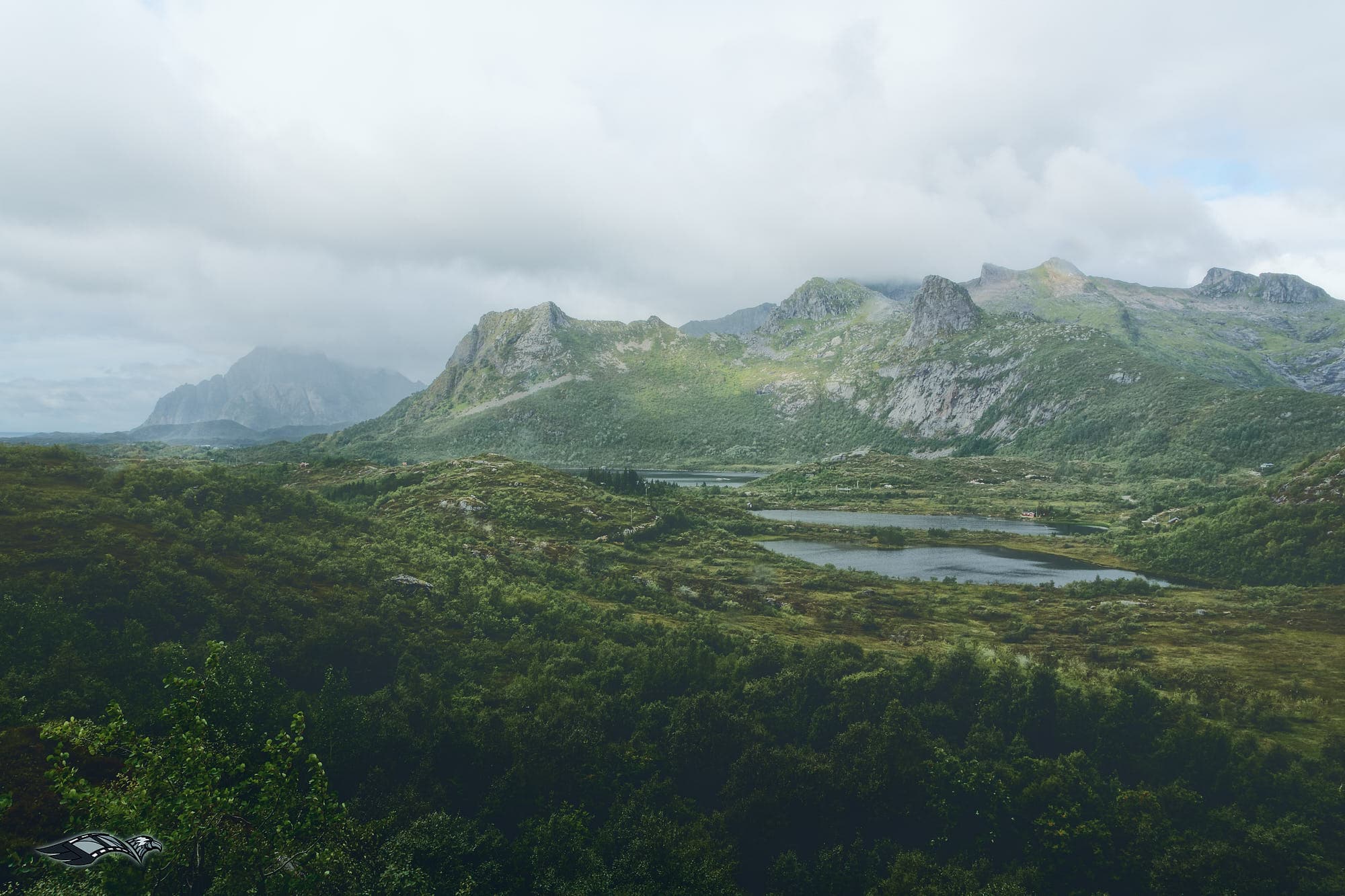
A silent photograph is not necessarily an empty photograph. It does not necessarily represent a still sea, a snowy landscape, or a lone tree in the fog.
Silence can also appear in the heart of a dense forest, on a nocturnal street, facing imposing architecture or in the middle of a troubled landscape. It is born less from what we photograph than from the way in which we organise the elements present in the image.
To photograph the silence it therefore consists of reducing unnecessary prompts, creating a clear visual hierarchy and offering the eye enough space to linger.
An image breathes when it's not trying to show everything at once. 😜
It is easy to associate silence with minimalist compositions: a horizon, a few lines, a distant silhouette or a large uniform surface.
These images can actually convey a sense of calm. But minimalism isn't a mandatory condition.
A photograph rich in detail can also remain silent, as long as these details all contribute to the same intention. Conversely, an image with very few elements can appear agitated if these compete or direct the gaze in several opposite directions.
Photographic silence therefore does not depend solely on the number of elements present. It depends above all on their relationships.
A silent image generally has:
Silence begins when each element ceases to claim our attention separately. 🤓
Negative space naturally plays an important role in this type of photography.. It can take the form of a sky, a shadow, a body of water, a wall, a mist, or a deliberately un-detailed area.
But this space is not necessarily empty. It acts as a pause between various visual information.
In music, a pause does not eliminate the melody; it allows it to exist. In photography, quiet areas perform a comparable function. They give more weight to essential elements and prevent the entire surface of the image from being occupied with the same intensity.
The challenge, therefore, is not to mechanically remove objects, but to alternate between active and quieter zones.
A rock texture can be very pronounced, while a sea smoothed by long exposure becomes a transition. A lit facade can draw the eye, while a dark street offers it a space for rest. A detailed branch can structure the foreground, while mist gradually erases the background.
It's this difference in density that gives the image its rhythm.
Many photographs lack breathing room because everything in them is given the same importance. 🤔
The foreground is spectacular, the sky is highly contrasted, the colours are saturated, every detail is enhanced and several luminous elements simultaneously draw the eye. The image may then be technically impressive, but visually exhausting.
To let a photograph breathe, It must be accepted that part of the image remains in the background.
This assumes choosing:
This choice begins as soon as you start shooting. It then continues to develop, as visual hierarchy depends as much on composition as it does on light, contrast, colour, and level of detail.
A silent image does not place all its elements in the foreground.
On the ground, silence is often built by elimination. Before triggering, it is useful to examine the edges of the frame, the dominant lines and small areas of high contrast. A branch fragment, a light-coloured rock, a splash of colour or an artificial element can be enough to create unnecessary tension.
These elements are not always problematic because they are ugly. They become so when’they interrupt the natural flow of the gaze. A slight shift, a lower viewpoint, a tighter frame, or a few seconds' wait can be enough to simplify the overall composition.
This approach joins the’The idea of not wanting to photograph everything. However, this is no longer a case of choosing between several possible subjects, but of choosing what deserves to remain within a single image.
Silent photography is often born from these small, invisible renunciations. 🤓
The gaze does not scan a photograph in a perfectly linear way. It jumps from one contrasting area to another, follows certain lines, returns to familiar shapes and stops on details that seem important to it.
A breathable composition does not prevent these movements. It simply avoids making them too rapid or too numerous.
To slow down naturally the gaze, several means can be used:
These visual pauses allow the viewer to linger on the image instead of just skimming over it. Silence appears when the gaze is no longer continually driven towards a new event.
A spectacular light doesn't necessarily have to conflict with silence. But it must be controlled.
The very strong highlights, brutally open shadows, and local contrasts applied everywhere produce an image that constantly strains the eye. Conversely, more progressive lighting creates transitions and allows certain areas to exist with greater restraint.
Side lights, whether diffuse or grazing, are particularly interesting as they reveal volume without necessarily exposing everything. This is clearly my favourite light, this in-between; after the bustle of the day and before the night's extinction.
The shadow then retains an essential function. It does not represent missing information that would systematically need to be retrieved. It can become a material, a depth or a zone of silence.
A photograph often breathes better when not all its shadows are brightened and not all its highlights are brought back to an average value. Some parts of the image may remain discreet, mysterious, or almost mute.
At the time of processing, the temptation is great to improve every part of the photograph. 🤪
We increase the foreground microstructure, strengthen the sky, add clarity to distant elements, open up the shadows, and accentuate every available detail. Little by little, the image loses the hierarchy that existed at the moment it was shot.
To preserve the silence, development must remain selective. Local contrast can be reserved for the main subject. Peripheral areas may receive less sharpness or texture. Saturation can be contained within secondary elements. Certain colours can be brought closer together to create continuity rather than a succession of accents.
The aim is not to make the image soft or dull. It's about managing your energy. All that is technically recoverable does not necessarily have to become visible with the same intensity.
Certain colour combinations naturally create more tension. Complementary colours, significant differences in saturation or small, very bright touches immediately attract the eye.
They can be useful when they support the subject. But they become noisy when they appear accidentally in multiple parts of the image.
A more restrained palette often promotes a sense of unity. The tones don't need to be dull: they primarily need to interact with each other.
Mineral blues, cool greens, earthy browns or contained warm lights can create a very present atmosphere without multiplying visual appeals. Coloured silence does not mean removing colour. It means preventing it from speaking in several directions at once.
A quiet place naturally facilitates this search, but it is not essential. In a city, silence can appear by isolating a figure amidst dark architecture, using the reflections of a wet street, or by letting large areas of shadow surround a few lights.
In a dense forest, it can arise from a repetition of trunks, a background softened by mist, or localised light that unifies the scene.
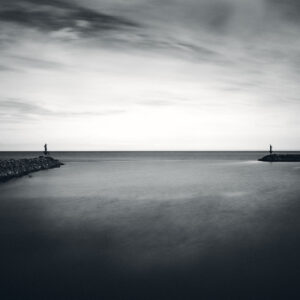
Faced with a rough sea, silence can come from a stable framing, a simple horizon, and a long enough exposure to transform movement into continuous matter.
So it's not necessarily about photographing a silent world. It is about finding, within this world, an organisation that soothes the relationships between its elements. Not always so simple, is it? Leave your experience in the comments below. 👇
One of the most difficult stages is recognising when the picture is finished.
It is always possible to add a little contrast, to brighten a new area, to enhance a colour or to correct an additional detail. However, each intervention modifies the overall balance.
A silent photograph sometimes asks you to pause before everything is perfectly demonstrative.
She accepts a degree of suggestion, obscurity, or incompletion.. She doesn't reveal all her information immediately. She leaves the viewer time to complete what they see with their own feelings. This restraint is not a lack of control. On the contrary, it can become one of the most demanding forms of Photographic mastery.
Photographing silence isn't just about seeking out deserted places, peaceful landscapes or minimalist compositions. It's about learning to distribute attention.
The framing eliminates certain tensions. The composition creates a hierarchy. The light reveals without explaining everything. The development strengthens some areas and allows others to recede.
The image doesn't become empty. It becomes available. It leaves enough space for the subject to exist, for the eye to move and for the spectator to enter with their own sensitivity.
In a universe saturated with fast, contrasting, and demonstrative images, this breath perhaps constitutes one of the most precious forms of photographic language, in my opinion. 🤔
Thank you for visiting the blog and for taking the time to share your thoughts on the gaze and photographic creation.
See you soon,
David