Vous aimez mes articles et mes films de terrain ? Laissez-moi votre email : je vous préviens à chaque nouvel article et à chaque nouveau film sur YouTube, avec une citation en prime.
Pas 40 mails par semaine : j'ai aussi des chemins à explorer !
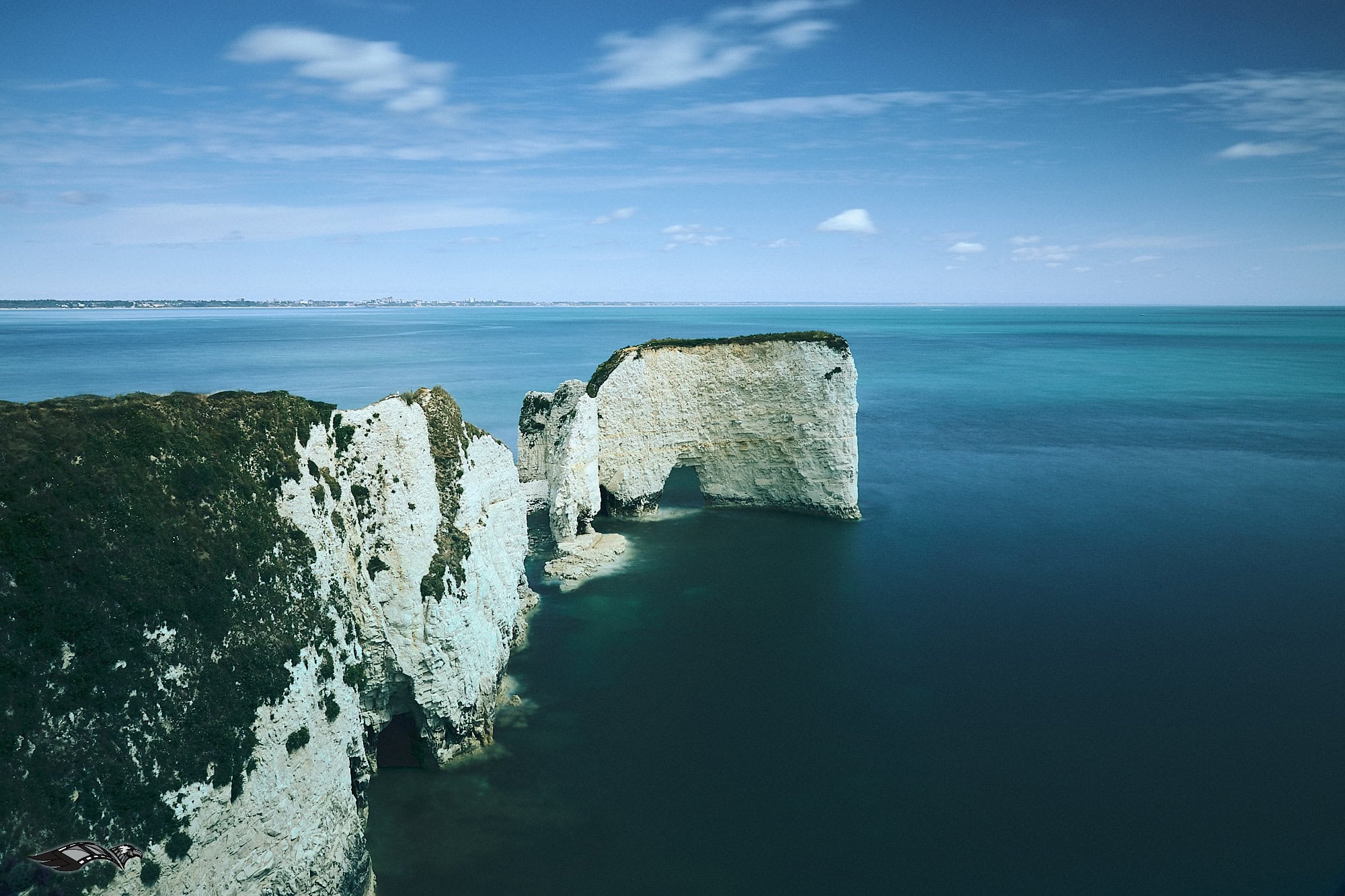
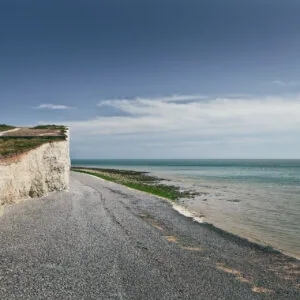
Old Harry Rocks, the Jurassic Coast (Dorset and Devon) England
In a photograph, it's not all about the subject, the light and the colour.
Sometimes it's the emptiness, the visual silence, the apparent absence of information that gives an image its expressive power..
In this article, we explore why and how this “void” or negative space is much more than just a background and can become a tool for composition, emotion and even visual storytelling.
1. What is negative space? An essential definition
In photography, negative space refers to the area around the main subject which is not occupied by it: an empty sky, a calm stretch of water, plain walls, blurred areas or simple colours. In the vocabulary of design, we sometimes speak of white space, a term borrowed from typography, where the absence of elements plays a structuring role.
This is the other side of the subject (or positive space). This is where the subject attracts, intrigues and captures attention, the emptiness around it gives it breath, scale and meaning.
2. Visual silence: Because the eye needs to breathe 🧘
To understand the importance of emptiness, a simple metaphor suffices: In music, silences are just as important as notes. They give rhythm and time, and allow each sound to exist fully. Without silence, music would be a continuous flow, saturated or overloaded and difficult to follow..
By the same token, an image that is too “busy” wears the eye out. Without legible spaces to rest the eye, nothing really stands out. Emptiness, on the other hand, creates a visual pause, a place where the eye can stop, breathe and then move on to what matters.
3. Silence, emptiness and emotions : Playing with sensations 🧐
What makes negative space so fascinating is its ability to evoke emotions.
A subject surrounded by vast empty areas may suggest the’isolation, l’extent, l’immensity or the loneliness.
Large expanses of open sky or water accentuate the sense of space. peaceof deep silence or meditation.
A small element lost in an immense landscape can also provoke wonder, humility or inner reflection.
Unlike a composition loaded with multiple elements, here the emotion comes not from the visual narrative, but from the space itself.
4. Why emptiness enhances the Subject
An empty space around a subject does not mean absence of meaning: it means priority to the subject, by contrast.
4.1 Subject Isolation
Leaving plenty of space around the subject naturally isolates it. The eye is not distracted by other competing objects in the frame. This gives the subject a stronger presence.
4.2 Scaling
When we include a lot of empty space (sky, desert, sea), the subject becomes smaller in relation to this space. This play on proportion creates a powerful sense of scale, an effect often sought in nature and travel photography.
4.3. Simplicity and Purity
A frame that “breathes” is more legible. In a world saturated with images, simple compositions with negative space are immediately noticed because they aim to the essential and eliminate the superfluous.
5. Organisation and techniques of minimalist composition
Emptiness is not chosen at random. It has to be thought through, framed and controlled.
5.1. Rule of Third Parties and Placement of the Subject
The rule of thirds is often presented as a basic principle in photography, sometimes even as a school requirement. However, when it is used intelligently, it becomes a subtle tool for organising emptiness, and not simply to “place a subject well”.
In the context of negative space, the rule of thirds is used above all to create a gentle visual tension. By placing the subject on one of the strong points of the image, at the intersection of the imaginary lines, we deliberately free up a large part of the frame. This emptiness is not neutral: it becomes a field of expression, a breathing space that guides the eye towards the subject without overwhelming it.
Place a subject on the lower third with a vast sky above, or on a lateral third with an open expanse in the direction of the viewer's gaze, gives the image a silent dynamic. The viewer intuitively senses a direction, a potential movement or an expectation. Here the void acts as a promise Something could happen, but nothing disturbs the moment.
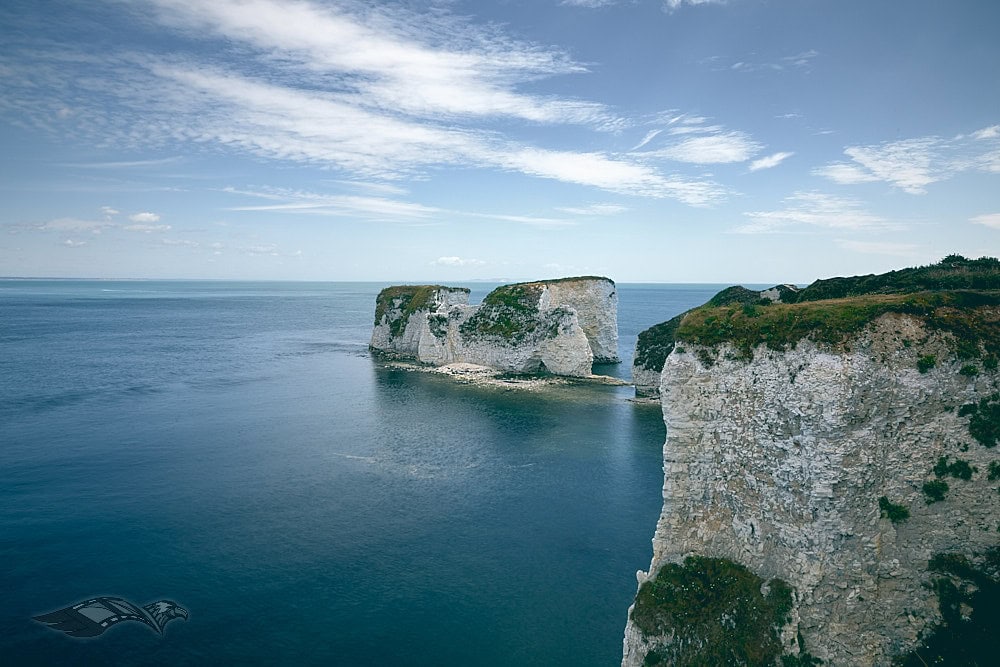
Old Harry Rocks, the Jurassic Coast (Dorset and Devon), England
In nature and travel landscapes, this approach is particularly effective. A lone tree, a distant human silhouette, an animal resting on the horizon: everything takes on a different dimension when the dominant space is not occupied. The eye moves freely, then naturally returns to the subject, reinforced by the contrast between presence and absence.
Finally, the rule of thirds applied to negative space avoids a common pitfall: a void that is too centred or too symmetrical, which can quickly become static or decorative. By deliberately decentring the subject, we give the void a narrative, almost emotional function.. It is no longer just a question of balancing an image, but of making what is not shown speak for itself.
6. Concrete examples from nature and travel
6.1. Horizon, sea, sky
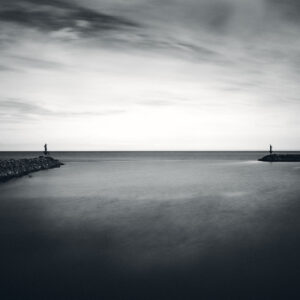
Seascapes with large swathes of clear sky or calm water allow the eye to linger on a simple, restful line.
6.2. Isolated fauna
A bird in flight or an animal alone in the distance surrounded by empty space reinforces the idea of freedom or introspection.
6.3. Architecture and urban landscapes
Even in the city, areas of absence (minimalist walls, plain façades) can be used as negative space to reveal the form and posture of a human or architectural subject.
7. The vacuum: a subject in its own right ? 😜
In some works, the void is no longer simply around the subject: it becomes the subject. Compositions where empty space dominates can evoke infinity, purity, or a meditative sensation, far beyond being a simple tool for highlighting.
8. Minimalism and visual storytelling
Photographic minimalism is not synonymous with visual poverty, but with clarity of intent.
A subject surrounded by emptiness can raise more questions than a busy scene: Who is he? Where are they going? How does he feel?
The negative space invites the viewer to participate mentally, to fill in the gaps left by the photographer.
9. Mistakes to avoid with negative space
Like any compositional tool, negative space can be misused. It's always a balancing act...
Too much emptiness without a strong subject can render the image little or no interest.
A subject that is too small and has no narrative element can leave the viewer with a feeling of hopelessness. disoriented.
The vacuum must be intentional, not by default.
10. Practical techniques for exploiting vacuum
Here are some simple tips for integrating negative space into your work:
💡 Search for plain or simple funds Clear skies, smooth walls, stretches of water or sand.
💡 Open the frame : Don't be afraid to leave seemingly “empty” areas.
💡 Using light High contrast or low light, to amplify the feeling of space or strangeness.
💡 Photographing wide landscapes : This naturally gives more room to negative space.
💡 Observing emotion Prefer spaces that evoke the feelings you want to convey (silence, freedom, solitude, peace).
11. Conclusion: When silence becomes expression
Emptiness is not an absence of creativity. In photography, it is a powerful tool for composition and emotion. It clarifies, purifies, meditates and, above all, gives the image room to breathe.
To use negative space is to recognise that the power of a photograph is measured not only by what it contains, but also by what it leaves out of the frame. It transforms a simple image into a visual experience, an emotion in its own right.
How do you express silence in your images?
Have you ever felt that moment when removing elements from your images becomes more powerful than adding them? Share your experiences, doubts or images in the comments below.