Nature & Travel
Continue the journey
Do you like my articles and my field films? Leave me your email: I’ll notify you of each new article and each new film on YouTube, with a bonus quote.
Not 40 emails a week: I have paths to explore too!

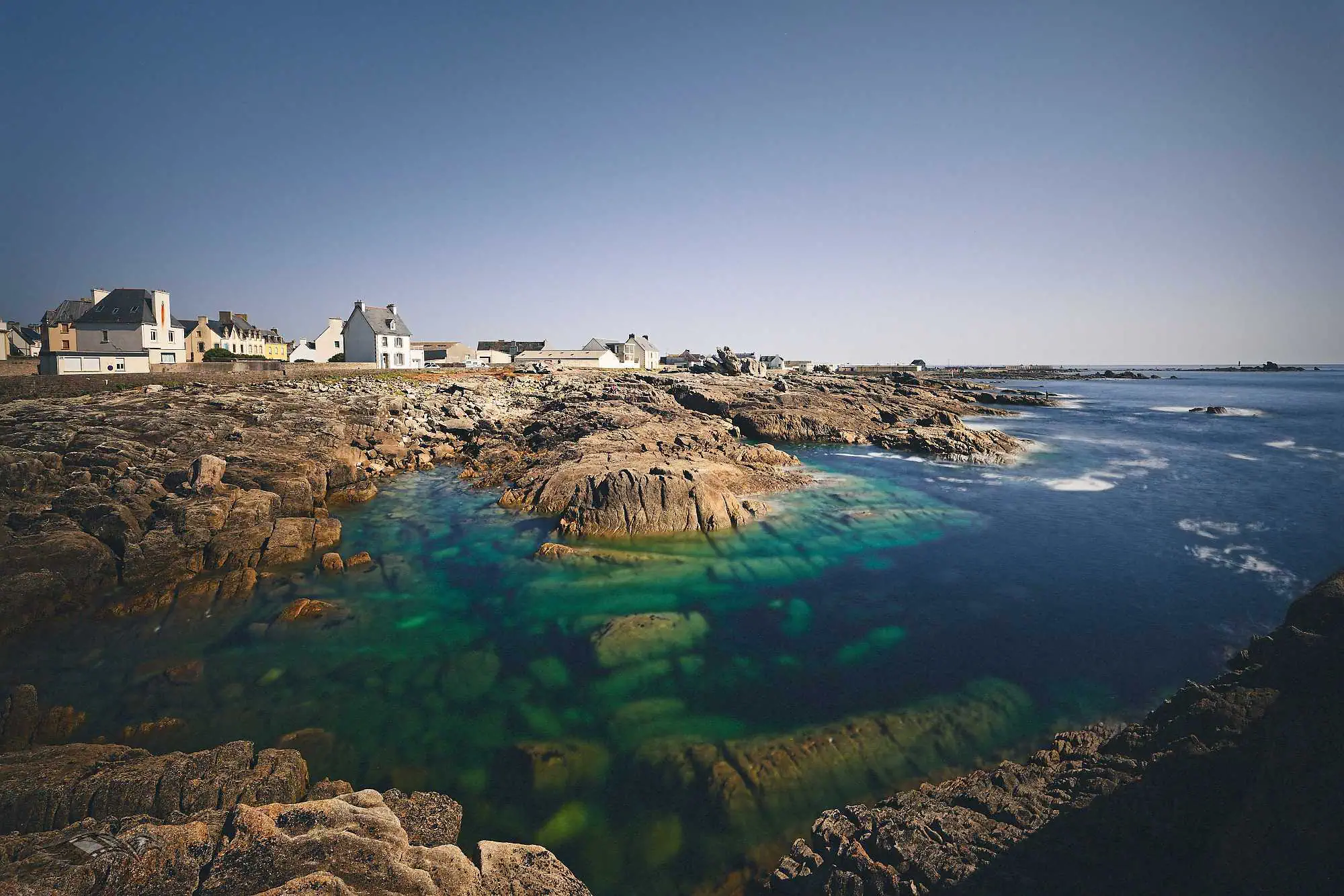
There are places where the subject stands out from the very first minute. And there are others where, on the contrary, Everything seems to be a subject at the same time. The rocks of Saint-Guénolé, on the tip of Finistère, they clearly belong to the second category.
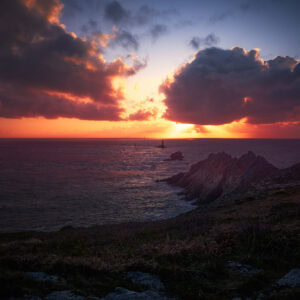
From the parking lot, the place hardly looks like much of a place. Then you walk a few meters, and suddenly everything changes: blocks of granite carved by erosion, tortured shapes, layers that seem stacked there by a giant hand, a clear light, and the Atlantic coming to pound everything relentlessly.
That day, I had no composition in mind. Just an intuition, born from my research beforehand: these rocks had something special. What I still didn’t know was that the real difficulty wasn’t going to be finding a photo. She was going to choose one of them, among hundreds of possibilities, before the tide closed the window.
When I arrived on the beach, I had no precise plan. Just a hypothesis: based on what I had seen upstream, these rocks possess structures and shapes sufficiently unique to merit the effort of traveling there. Once there, the hypothesis was confirmed. The formations are there, imposing and almost theatrical. The question now is what we can actually extract from them.
This is a moment I particularly enjoy in a photo shoot: the one where we don’t yet know what we’re going to capture, where we simply walk around, look around, and let the place reveal itself. No rush. We observe before deciding.
I brought my RF 14-35 mm with me. It’s no coincidence. I love what the wide-angle lens allows you to do with depth: stretching the shots, creating distance between the foreground and background, Playing with optical distortion is not seen as a flaw to be corrected, but as an artistic choice.
Facing these rocks, the idea was simple on paper: find a framing that would allow two formations to be included, using the layers and lines of the terrain as visual guides, to naturally draw the eye towards the two main rock masses in the background. Simple on paper, just.
Once the first overall images have been taken, those showing the general shape of the rocks leading towards the main subject, another problem appears and that is often the one, the real trap of a place like this. The possibilities for composition are everywhere. Every angle offers something. Every rock, every ledge, every crack seems worthy of a photo.
The most difficult part wasn’t finding a subject; it was eliminating everything that could distract the viewer’s attention. I was looking for a simple image, with the rocks and the sea as the main focus, and especially enough space to let the scene breathe. This is exactly the trap I was talking about in The Mistake of Trying to Photograph Everything: Faced with a place that makes you want to capture everything, the real skill lies in knowing how to give up.
We had arrived in the middle of the afternoon. The light was still strong, quite harsh, quite vertical; not the most flattering light for this kind of landscape. And the tide was rising. Quickly.
This constraint has changed the way I work. I‘I modified the framing to play with a more triangular composition, associating the rocks with a long pose on the waves that surrounded them. But with the tide rising, we couldn't linger. A time constraint, paradoxically, often helps to make a decision. Knowing that we won’t be able to try everything, We stop trying everything and we start choosing.
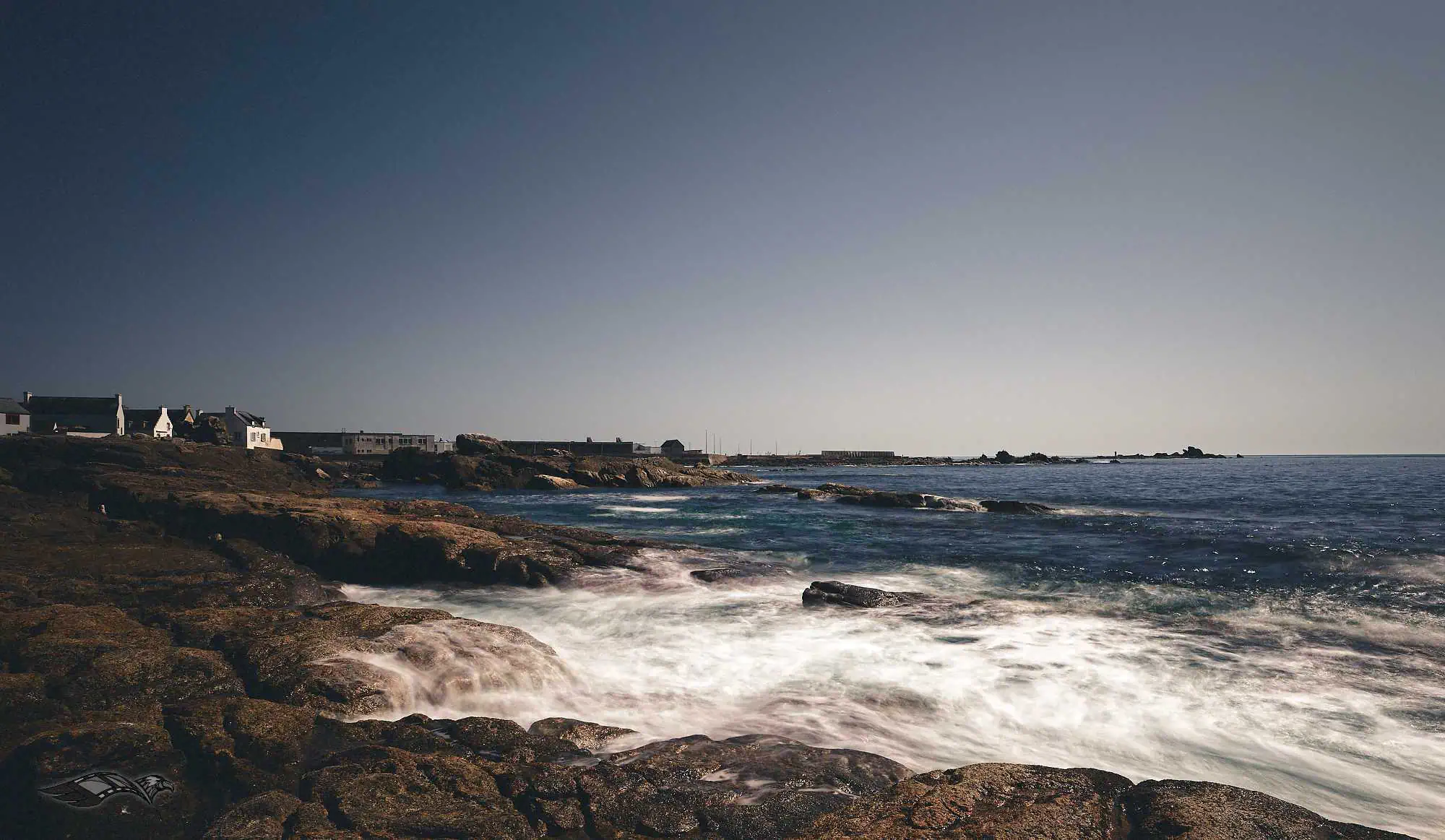
That’s when the situation took a turn. Feeling the tide rising, I wanted to look at things differently: to make an opposite composition, to accept wetting my feet and the tripod, and to turn towards the ocean rather than turning my back on it.
From time to time, a good wave would rise — the kind that could yield something interesting with a long exposure, two to three seconds. Then I waited. The good wave. Without knowing for sure that the conditions would produce the image I had in mind. But that’s also what I love about this kind of outing: observing, trying, sometimes waiting, and coming back with a photograph that one hadn’t imagined in the first place. That reflex, not to trigger it immediately, to let the scene come to you, is the same one I talk about in Learning not to trigger — except that here, the sea itself was imposing patience on me.
To maximize this effect of depth, I continued to work in a wide angle, often getting close to the ground — the very flat target, very close to the rocks. I love that sense of space in an image, that impression of being able to breathe in it.
On one of the compositions, a large gap on the left resonated with a rocky structure at the bottom and with the striations visible on the rock, creating a convergence of almost triangular shapes. And it was when I observed this up close that something struck me: The rocks read a bit like wood. There is an internal texture, a construction in layers, lines that can serve to guide the eye and to structure a composition—provided that one takes the time to really look at them.
I also chose to move forward as far as possible into the water to return to the land, rather than remaining facing the ocean as everyone does naturally. A simple way to escape the most obvious gaze in a place.
One final composition particularly struck me: beautiful layers that rose up to a huge rocky mound. During the long exposure, each wave motion slightly illuminated the edges of the rocks, creating a contrast between the dark rock and a very, very blue ocean.
It’s this contrast that I’ve been looking for in my images for a long time — this mineral blue, cold and deep, which comes to oppose the raw and textured material of the rock. That day, Saint-Guénolé gave it to me almost effortlessly.
I left with several solid compositions, and especially with that special feeling, the fact of having really lived in the place rather than simply having passed through it with a camera in hand. The sorting and development still had to be done, but the essentials were already there: a guiding thread, an intention, a gaze.
It’s the entire narrative of this outing — the anticipation, the hesitations, the sound of the waves, the changing light — that I wanted to capture in the film above, in addition to this article. If you want to experience the outing rather than read about it, the video is available. on my YouTube channel.
And if this mineral blue and these rocks sculpted by the Atlantic have left as much mark on you as they did on me, The Fine Art images from this outing are visible in my galleries.
Thank you for visiting the blog, and Don’t forget to create your vision.
See you soon,
David